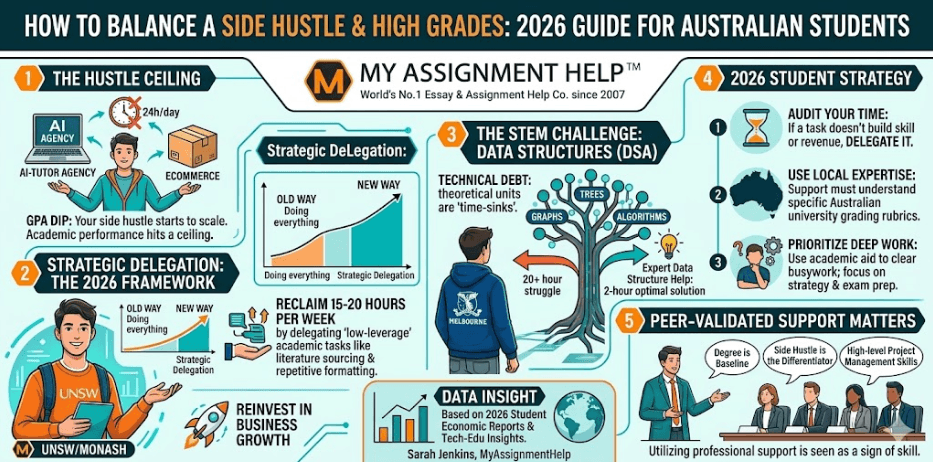
The “broke student” trope is officially dead in 2026. In its place is the Student-Entrepreneur, a demographic managing everything from AI-tutor agencies to boutique e-commerce brands while pursuing full-time degrees at institutions like Monash University or UNSW. However, as many in the Sydney and Melbourne startup scenes will tell you, the “hustle” has a ceiling: your own 24-hour day.
When your side hustle begins to scale, your academic performance often takes the first hit. According to recent 2026 student sentiment data, the transition from “hobbyist” to “business owner” is where most Australian students experience a GPA dip. The secret to survival isn’t working harder—it’s the shift toward outcome-oriented delegation.
The “168-Hour Audit”: A 2026 Productivity Framework
Top-performing students are no longer trying to do it all. Instead, they are applying the same delegation principles to their studies that they use in their businesses. This involves identifying “low-leverage” academic tasks—such as initial literature sourcing or repetitive formatting—and utilizing professional support.
By opting for localized assignment help in Australia, students are reclaiming an average of 15–20 hours per week. This “found time” is then reinvested into high-impact business activities, like client acquisition or product development on platforms like Gig-AI Australia.
Mastering STEM: The Data Structure Bottleneck
For students at the University of Melbourne or ANU enrolled in Computer Science, the bottleneck is almost always technical. Theoretical units like Data Structures and Algorithms (DSA) are notorious “time-sinks.” A single complex assignment on balanced trees or graph theory can effectively shut down a student’s business operations for a week.
Smart student-founders treat these hurdles as technical debt. Leveraging expert Data Structure Assignment Help allows them to see the “optimal solution” immediately, turning a 20-hour struggle into a 2-hour learning session. This isn’t just about the grade; it’s about maintaining the momentum of your venture.
2026 Strategy for Student Success
- Audit Your Time: If a task doesn’t contribute to your long-term skill set or your business revenue, delegate it.
- Use Local Expertise: Ensure your support understands the specific grading rubrics of Australian universities to avoid rework.
- Prioritize Deep Work: Use academic assistance to clear the “busy work,” leaving your peak cognitive hours for business strategy and exam prep.
Why Peer-Validated Support Matters
In the current Australian job market, a degree is the baseline, but your side hustle is the differentiator. Employers are increasingly looking for graduates who have balanced real-world commercial success with academic rigour. Utilizing a “networked” approach to your education—using tutors and professional editors—is now seen as a sign of high-level project management skills.
See also: Top 10 Technology Trends to Watch This Year
Frequently Asked Questions (FAQ)
Q: How do I choose a support service that won’t compromise my academic integrity?
Look for services that provide “model answers” and logical breakdowns. The goal is to use the help as a high-level study guide to accelerate your own understanding.
Q: Which side hustles are most popular for Australian students in 2026?
We are seeing a massive surge in AI-prompt engineering, specialized data auditing, and regional e-commerce management focused on sustainable Australian goods.
Q: How does specialized tech help (like Data Structures) impact my career?
It ensures you don’t just “pass” but actually master the logic. Seeing how an expert optimizes a data structure provides a professional standard you can apply to your own coding projects.
Author Bio
Sarah Jenkins Sarah is a Senior Content Strategist at MyAssignmentHelp, specializing in productivity frameworks for the modern Australian “Portfolio Student”. She has consulted for student-led startups in Sydney and Melbourne on how to integrate academic excellence with commercial growth.
References & Data Sources
- Australian Student Economic Report (2026): “The Rise of the Portfolio Student.”
- Tech-Edu Insights (2025): “Managing Technical Debt in STEM Education.”
- Regional Employment Trends (2026): “Why Side-Hustles are the New Internships.”